
Macro-hard KO Micro-soft
When Nasdaq Begins Pricing America by “Hardness”

Last Thursday and Friday, the financial markets didn’t just drop—it felt like someone abruptly pulled the plug. The Dow is screaming; the macro-crowd is whispering about recession. But inside the Nasdaq, something far more brutal occurred: it stopped acting in unison. It began picking favorites.
First, let’s revisit an old Silicon Valley joke.
Microsoft. This is a great company that once changed the world, but the literal meaning of the name has always been—Small, and Soft. Meanwhile, the company Elon Musk registered years ago was called Macrohard—Big, and Hard. It was crude, blunt, and ungentlemanly, but it was profoundly honest.
Wall Street once treated it as a joke by a Silicon Valley “big boy.” Now, they are taking it seriously.
Because in the market of 2026, an unrefined but honest truth is finally allowed to be spoken aloud: Micro-soft is not enough. Macro-soft is not enough. You must be Macro-hard.
If you have read my definitions of System C / C.O.D.E., none of this is surprising. The “America” we are familiar with is indeed over. Detroit, Boeing, steel, unions, treaties—that was Old America.
New America is not attempting to fix it. It has simply formatted the old system.
System C no longer expands by occupying land; it expands via Push Updates. It does not establish sovereignty through borders, but through the hard-linking of compute, protocols, energy, and evolutionary speed. When these elements form a closed loop, America ceases to be a geographic nation and becomes a Network State floating above the earth.
The only problem is—not every tech company is worthy of this system.
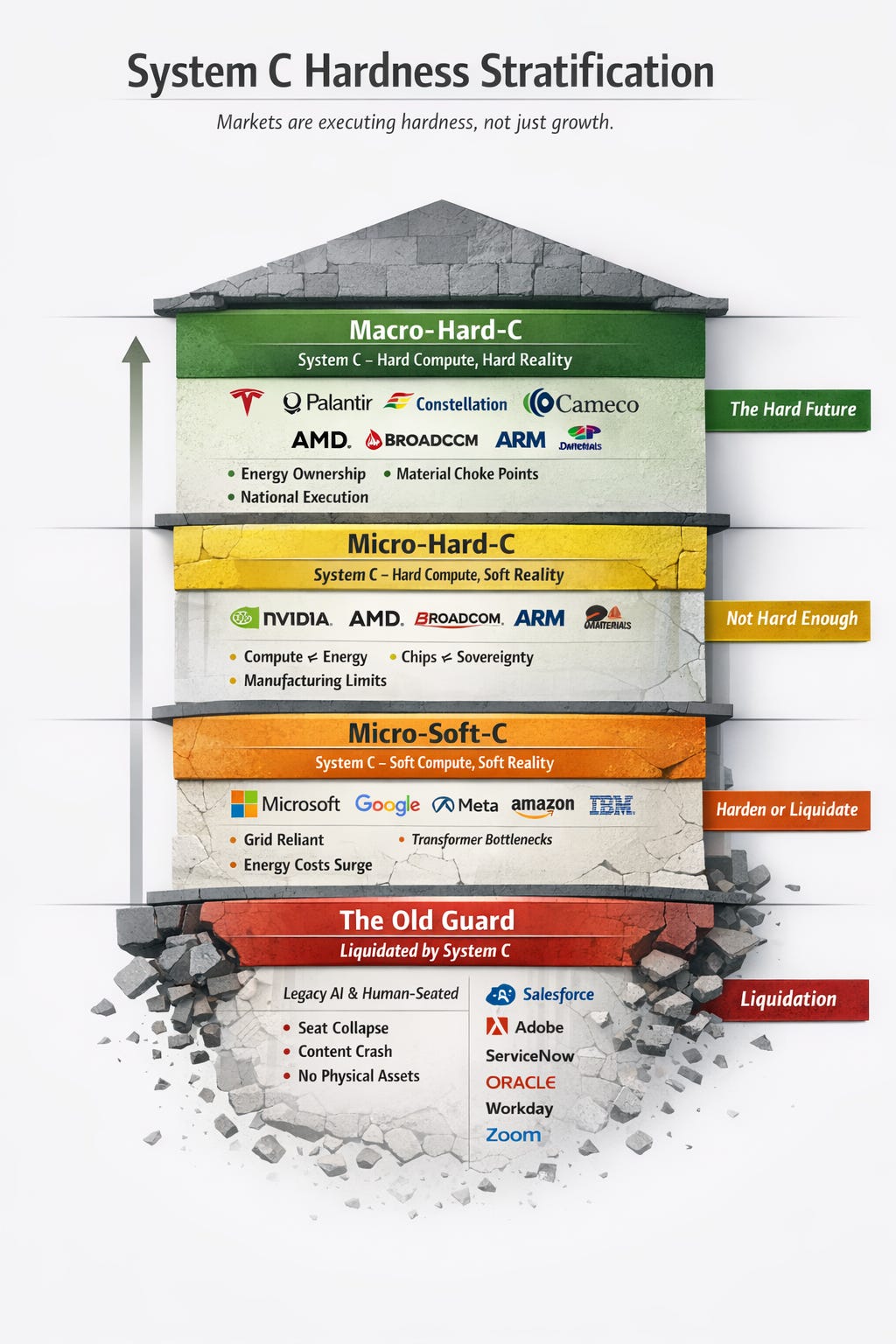
The First Layer: The Purge of the Old Guard
Salesforce. Adobe. ServiceNow. Workday. Zoom. Their decline was not elegant, but the logic was spotless.
For too long, these companies were mistaken for “Tech.” In reality, they are toll booths on human inefficiency. Seats, workflows, collaboration, subscriptions—they are all essentially taxes on human heads. When AI Agents arrived, that tax base simply evaporated. When one agent can replace ten white-collar workers, a corporation doesn’t cut “modules”—it cuts “people.”
It is brutal and simple: in a system designed to “eliminate human seats,” any company charging by the seat has no future. This is not an adjustment; it is a liquidation. It is not a trend miscalculation; it is a temporal displacement.
The Second Layer: The Hostage Crisis of the Brains
Microsoft. Google. Meta. Amazon. They undoubtedly belong to System C. But in this downturn, they exposed an embarrassing identity—Tenants.
Search is no longer an algorithmic problem; it is an energy problem. Large models are no longer a parameter problem; they are a problem of grids, transformers, and permits. Nadella has laid his cards on the table: the majority of Microsoft’s AI CapEx is flowing into energy and land. This is not the glory of a tech company; it is a debt statement from the physical world.
The true meaning of Micro-soft was punctuated by the market: grand dreams, but total physical dependency. They have not failed, but they have been served a Margin Call on Reality.
The Third Layer: The Falling Myths
Nvidia remains the King of Compute. Broadcom, AMD, and Arm remain indispensable. But the market has stopped paying for the “Pure Compute Narrative.” When energy, manufacturing, and geopolitics become hard constraints, a powerful chip is only half a ticket to the future. Nvidia has no flaw; the issue is that Compute is no longer the destination—it is merely the appetizer.
If you aren’t “Hard” enough, even a myth must lose its voice.
The Final Layer: The Coronation
Only one word has been truly repriced: Hard. These companies are not light; they are not elegant. They aren’t even very “Silicon Valley.” But they control the physical interfaces that System C cannot bypass: Energy, Materials, Bodies, and the Protocols that enforce the rules.
Constellation owns the rights to nuclear fission;
Cameco controls the fuel;
MP Materials has its hands on the periodic table;
BWXT puts reactors into the real world.
Tesla, via Optimus, has made the jump: code now drives atoms.
Palantir is not software; it has written the sovereign logic of System C into the defense, grid, and scheduling protocols. It is drafting the terms of the Network State.
These assets rose without apology. They aren’t telling stories—they are the physical prerequisites upon which the stories depend. They are the infrastructure of System C.
Defining “Hardness”
“Hard” is a rational, verifiable, and anti-romantic filtering mechanism. Last week, the Nasdaq divergence laid these standards bare.
A true MacroHard entity must possess at least one of these four types of hardness:
Energy Hardness (Energy Sovereignty):
Do you own the constant energy and the “Kill Switch,” or do you own a contract that can be repriced at any moment? Rented power always carries interest. Only entities that can “breathe” during a system shock are capable of evolution.Physical Hardness (Embodied Intelligence):
Can your intelligence be converted directly into physical work? If an algorithm stays behind the screen, it is a ghost. True hardness is a Push Update that changes the way the physical world moves.Supply Hardness (Supply Sovereignty):
Do you control the critical supply chain, or do you rely on global logistics that could be cut at any moment? When the supply chain becomes a weapon, only those with their hands in the periodic table possess self-repair capabilities.Institutional Hardnes(Protocol Sovereignty):
Are you embedded in national-level, infrastructure-level decision-making? Can you be called upon directly during a defense or energy crisis? When protocols replace laws, true hardness is found in whoever owns the Interpretation Rights.
These are not slogans; they are thresholds. They determine whether a company is an architect of System C or just a spectator listening to stories.
The Rise of New America (Universe C)
The real Alpha is hidden in the process of America “hardening”:
Cloud providers attempting to move from energy tenants to energy owners;
Industrial firms pushing AI from “assistant” to “controller”;
Defense, nuclear, and the grid—long-suppressed assets—finally being allowed back into the financial narrative.
This is no longer a vision statement. It is an execution log. This is not an elegant path. Hard means slow, expensive, and political. But it is where the returns live.
In the future world, Geography will no longer be the sole standard for a nation. The world will be divided into Users and Admins.
Some nations will provide ore, manufacture parts, and consume goods—they are the producers and users. C.O.D.E. is an attempt to make America the Admin. It provides the infrastructure for the digital age. It expands not by occupying land, but by Pushing Updates.
When compute, protocol, energy, and speed are integrated, America ceases to be a geographic country. It becomes a Network State floating above the earth.
In a world governed by Push Updates, code is abundant; hardness is scarce. It doesn’t matter how grand your narrative is; it matters if you can keep running when the system is unplugged.
Micro-soft keyboardists are still charming, but charm is devaluing.
Macro-hard construction sites are dusty, but they control reality.
The future didn’t arrive slowly; it arrived all at once, losing patience with those who were not hard enough. Now, only one question remains for those in System C:
Exactly how hard are you?
Hardwired. Interesting points of view, as always.
I have really enjoyed reading your analysis using the systems approach to explain the dynamics underway globally. So much of the rhetoric is still based on the good/bad political binary so it completely ignores all the context and nuance actually occurring in extremely complex systems.
We are clearly in a “creative destruction” geopolitical mode now, with the collapse of the post 1991 unipolar moment and physical reality once again rearing its ugly head. It feels like post November 2024, the US System C accelerationist are firmly in control of the state power of System A to acquire as much access to energy and “sockets” as possible to mitigate System B midstream dominance.
I would assume a similar System C emerges rapidly within the System B as well, since it controls so much of the midstream and finished product required to make System C successful. The kinetic physical and political battles now seem to be access and control of the primary source inputs. As Doomberg said several years ago, “in the war between platitudes and physics, physics stands undefeated.”