
WAR III Has No Battlefield: The Supply-Chain War
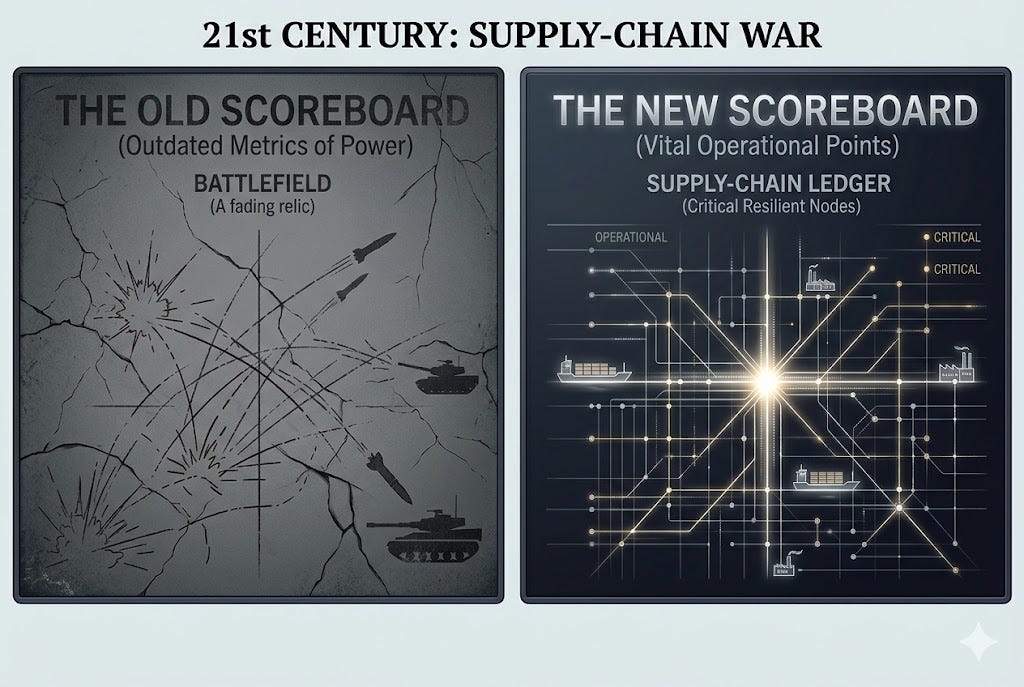
the 21st century's wars are won on a ledger, not a battlefield

In 416 BC, on the island of Melos, Athenian envoys delivered to a doomed weaker state the founding maxim of Western realism: the strong do what they can, and the weak suffer what they must. For twenty-four centuries this sentence has been enshrined as the final grammar of power. But it hides a premise no one ever interrogated — that strength is settled by what you can take from whom. The strong take land, take tribute, take people. Much of the history of international relations is a footnote to this one line.
In the 21st century the grammar of power has been rewritten, and the logic of Melos has failed. Let me show you the proof.
Land, Fuel, Supply Chains
For three and a half centuries the thing fought over was land. The treaty that ended the Thirty Years’ War at Westphalia in 1648 did one thing above all — it drew lines; every great settlement after it, Utrecht, Vienna, was an argument about borders. To win was to hold more ground than before.
Then the thing became fuel. The switch has a precise coordinate: June 1914, weeks before the First World War, when Churchill pushed the British government to spend £2.2 million for 51% of the Anglo-Persian Oil Company. The Royal Navy was converting from coal to oil, and Britain had no oil — so a remote patch of Persian desert, worthless in itself, was suddenly worth reaching across the world for. That logic burned for a century: Japan struck Pearl Harbor over oil, Hitler broke his army reaching for the Caucasus oilfields, Britain and France fought Suez over a canal. Strip 20th-century geopolitics down and most of it is the geography of fuel.
Land can be occupied; fuel can be bought and stockpiled — both are things, visible, seizable by armies, writable into treaties. Then the object of contention itself underwent a phase change. A new kind of thing appeared, one the strong cannot take no matter how strong they are, and still cannot route around. This is the supply chain. A supply chain is not a thing — it is a capability: the capability to organize atoms into a chain no one else can reproduce.
This distinction is the pivot of the whole argument. The capability lives not in any single link but in the whole interlocking chain — upstream ore, refining, precursors, assembly, ancillaries, logistics, the industrial cluster — each meshed into the next, none removable. A single node you can buy; the whole chain you cannot. What cannot be copied is never one process — it is the chain itself. Saudi Arabia sits on oil and was a power in the age of fuel, but it holds only the most upstream link and no downstream, which is exactly why it is pouring hundreds of billions into NEOM, straining to grow a chain. Resource-rich and chain-poor are simultaneously true. China, by contrast, is resource-poor at home, yet it gathers the world’s ore, refines it, builds with it, supplies its own ancillaries — and has grown a chain no one else can plug into. What it won was not the ore. It was the chain.
One more misreading has to be cleared first. “Others cannot route around you” comes in two forms, a hair apart. One is extortion: I hold one process, I cut you off to show you, I make you come begging. The other is creation: I can make, at a cost and quality no one else can match, the thing the whole world wants — so you cannot do without me. The first is the chokehold; the second is value creation. The essence of the supply-chain war is the second: victory turns not on who can throttle whom, but on who can make the thing others cannot live without. The chokehold is a by-product of the capacity to create, a weapon drawn now and then — not the body of it. Whoever mistakes it for the body has misread the war from the start.
And there is a theory that has written precisely that inversion into state policy. The “weaponized interdependence” of Henry Farrell and Abraham Newman holds that whoever controls the central nodes of the global network — dollar clearing, SWIFT, chips — can coerce adversaries by threatening to cut them off. This is no academic abstraction: by way of one Trump-administration official it became the intellectual origin of the chip controls that ran across two presidencies, and Washington has aimed it at far more than China — its long-arm jurisdiction lands on allies just as hard. The trouble is that it describes the symptom of this war, not the pathology. The chokehold is subtraction: cut China off from chips, and it is China that is hurt — but no third country needs America more for it. Every time you sanction an ally, every time you reach with the long arm, you simply hand every country you have throttled, and every country that fears you might, one more reason to build a chain that routes around you. You can throttle others only because you first created something they cannot live without; once the creation drains away and only the throttling is left, the nodes fail one after another — adversaries go around, grow their own, render yours dead. To treat the chokehold as the source of power is the starting point of System A’s misreading of this war. It has enshrined a symptom of decline as a national strategy.
Land is what you occupy, fuel is what you sell, a supply chain is what others cannot live without. The first two the strong can take; the last the strong can only create. The logic of Melos fails here: in the 21st century strength is no longer settled by what you can take, but by what the world cannot live without you creating.
The Verdict Is on Another Scoreboard
The phase change in the object of contention rewrites the rule for who wins. Fighting over land, you count the ground held; over fuel, the oil controlled; over supply chains, only one thing counts — when the fighting stops, whose position that others cannot route around has moved up. Military force, territory, narrative, sanctions are all surface flow; the net change in supply-chain position is the only ledger underneath.
It survives the hardest interrogation. Russia lost Europe and turned to India and China — did its supply chain grow stronger? No. It fell from a price-setter — European pipelines, long-term contracts, a seat at the settlement table — to a discounted supplier, crude trading at a chronic discount, shipping at the mercy of someone else’s fleet. Its position did not strengthen; it slid from node toward raw-material spigot. And nuclear weapons — do they not still decide everything? Precisely because they still decide everything, they confirm the rule: the bomb is the ultimate instrument of the last era’s contest of wills, and it can veto your physical annihilation, but it cannot veto the other side holding nearly 90% of the world’s rare-earth refining. By freezing war’s highest form, it forced the contest down into the one axis it cannot reach. The bomb is not the exception to the rule. It is the rule’s witness.
What is measured is never how much you sell, but what the world cannot live without you creating.
So turn the ledger to System A’s page: today, what does the world actually depend on America to create? The list is short, and every item on it is shrinking. Dollar clearing — being hollowed out, a turn at a time, by de-dollarization. EDA and high-end chip design — where the controls have only pushed the other side onto the fast track of self-sufficiency. The most advanced AI models — where the lead has narrowed from years to months, and the other side’s token volume has already overtaken. Add Hollywood and a handful of not-yet-replaced brands. The rest? The rest is no longer “what the world needs America to make” — it is “what the world has not yet had time to route around”: the dollar switch, the long arm of sanctions, the presence of the navy. The way America keeps the world dependent is decaying from being needed into being able to punish. That is the most precise definition of decline: when the value you create is no longer enough to keep people from leaving, you keep them only by the pain you can inflict.
The Form of War Has Changed Too
When the object of contention shifts from what can be occupied to what cannot be routed around, war no longer needs occupation, and therefore no longer needs a battlefield. The supply-chain war is usually invisible: chip controls draw no smoke, rare-earth embargoes leave no casualties, one line of routing config moves tens of billions of tokens from one country to another without a single bullet. It has no declaration, no armistice, no postwar — only the monotonic tightening of position.
This is why the war in Ukraine — the most 20th-century great-power hot war imaginable — could run four years and still not define the world’s agenda: it satisfies every variable in the old textbook, and sits on none of the axis where the new principal contradiction runs. While the things actually redrawing the map wore no resemblance to war at all.
Mainstream IR still cannot recognize this war, because it is still wearing the spectacles of WWII, identifying friend and enemy by the shape of missiles and planes. Those same spectacles make it misread its own favorite framework. Graham Allison’s “Thucydides Trap” has ruled the past decade’s China discourse — a rising power nears the incumbent, and structural fear ignites a war. The first half is right; the second half is wrong by one word. People assumed that war meant a hot war, and so they fixed their eyes on whether the Taiwan Strait would spark. But the trap never specified that the contest ends in fire. The real trap is not on the battlefield: one side’s supply-chain position rises, the other’s falls, the transfer of power completes — and not one shell need be fired for it. The hot war is not the opposite of the supply-chain war. The hot war is merely a coat it puts on now and then.
The One Point Where Old and New Overlap
Because the supply-chain war is invisible, humanity had never fought a visible one — until one exception, where the old world and the new happened to overlap at a single point.
Iran, spring 2026, was visible because it wore two faces at once: the form of the old world — missiles, decapitation, air supremacy, forty-two days of total victory — and the substance of the new — supply chains. The military shell won everything; the supply-chain core lost everything. America brought maximum military force to keep Hormuz open and could not, because keeping a strait open never depended on warships — it depends on refining capacity, energy corridors, the physical base of critical materials, and that base had already been lost, block by block, in steel and solar and batteries. When the fighting ended, Tehran opened an office, began issuing transit approvals at Hormuz, priced in a currency that was not the dollar — and the strait America fought the whole war to keep became someone else’s tollgate.
Looking back, those forty-two days may have been the real Thucydidean war. No great-power hot war — yet someone quietly swapped out the key to the strait.
A Chain That Runs One Way Only
Iran was not an outlier. It was the latest link in a chain that has run for twenty years. Steel: twenty years of anti-dumping, and China makes a billion tons a year to America’s under eighty million. Solar: twelve years of frozen lending, and China pushed past 80% of capacity. EVs: in 2025 BYD sold 4.6 million new-energy vehicles to Tesla’s 1.64 million. Chips: three years of controls, and SMIC built a generation-ahead process on generation-behind equipment. Each time Washington said this time is different; each time it ended the same, only faster — twenty years, three years, and for AI just eighteen months. And AI is the one link tariffs cannot even touch: what was lost before were atoms, and customs can stop goods; AI is tokens, it travels down fiber, and customs cannot stop light.
Not one link was taken by B’s design. B’s state firms do not chase returns and cannot go bankrupt; they buy the world’s ore and refine it cheap, necessarily into overcapacity, necessarily dumped. A’s capital chases high returns and walks out of low-margin manufacturing on its own. Two systems each executing their own physical constraints, together twisting this chain into a slope that runs one way only. A was not defeated. A slid down the logic of its own making.
And the other end of the chain is not empty. People keep saying globalization is dead. Is it? It is not. What died is A’s version — to enter my market, first accept dollar clearing, long-arm jurisdiction, and a side chosen by my definition. What replaced it is B’s version: I build your port, you take my goods, and almost nothing political is asked. An emerging country facing the two offers chooses A at a discount on its sovereignty, or B with its sovereignty intact. The world is not fragmenting. It is changing engines. What gets called “deglobalization” is only the vertigo of those standing on the old engine, watching the new one ignite.
This chain slid to Iran, and there it slid into sea power — what was lost before were economic tracks; this time it was national security. Maximum military force cannot defend a chokepoint whose physical base is no longer in hand.
To Fight a Supply-Chain War, You Must First Have a Supply Chain
Every kind of war has an entry requirement. For land you needed armies; for fuel you needed a navy that could reach the oilfield and hold it — that is what Churchill bought in Persia. The entry requirement for a supply-chain war is brutally simple: you must first have a supply chain. Not a market, not a currency, not carriers — the physical capacity to make the thing others cannot route around.
This is System A’s greatest blind spot, and its only cure.
The blind spot: A still believes this war can be fought with tariffs, sanctions, export controls, the seizure of Greenland. But every one of those tools assumes a designer on the other side of the table — someone who can be commanded, who can be cut off. The supply-chain system was not designed; it is a metabolism that grew, with no head to sever. Aim a tool built for a designer at a system that has none, and it hits nothing, faster each time. Every cure A prescribes is the wrong medicine.
And the one true medicine is singular: grow, again, a chain others cannot live without — by creating value the world cannot leave, not by throttling processes to force the world to kneel. There is no second road. Yet A holds it backwards: its capacity to create value atrophies down one track after another, while it bets every chip on the chokehold — raising tariffs, cutting off chips, drawing up entity lists, seizing Greenland. Bringing a rusting weapon to a war that measures who can make more. How does that win? How could it possibly win.
And this medicine A can barely swallow — the three-to-sixfold efficiency gap is a physical fact, capital will not leave high-return finance on its own to fill a structurally low-return industry, the window of dollar strain is measured in years and industrial reconstruction in decades, and no developed nation has ever completed reverse industrialization. The cure and the terminal diagnosis are the same thing. This is the deepest layer of the deadlock: it is not that A cannot find a way out — it is that A’s only way out is the very road it finds hardest, and least wants, to walk.
A Few Axioms
The whole argument, compressed into lines you can carry away on their own.
One. Every age fights over a thing, and that thing undergoes phase changes. Land, fuel, supply chains. The first two the strong can take; the last the strong can only create.
Two. The phase change sets the rule of victory. In the contest over supply chains, victory is settled by one thing — when the fighting stops, whose creation the world depends on more. The rest is surface flow.
Three. The phase change sets the form of war. The supply-chain war is invisible, off the battlefield, off the headlines. The Thucydides Trap is real, but it is not paid out on a battlefield — power transfers, and not one shell need fire.
Four. The entry requirement for this war is a chain others cannot reproduce. Its power comes from creation, not from the chokehold — the chokehold is its by-product, not itself. A system whose supply chain is shrinking, fighting a supply-chain war with tariffs and sanctions, is a navy with no ships declaring a naval war.
Five. You cannot win a war you were never trained to see — still less a war whose weapon you are holding backwards. The verdict does not arrive as an announcement. It is delivered one quarter at a time.
But all of this rests on one premise: that System A does not change.
And the premise is loosening. A is already trying to save itself — its political selection machine has begun to turn, and a new leadership is taking shape: industrial hawks turned out of the national-security bureaucracy, accelerationists piped from Silicon Valley into the White House, labor men coming up out of the factories and the unions. Their origins differ, their paths run opposite, and they converge on one thing — supply chains. No one designed this. It is the self-rescue reflex forced out by the physical pressure of a loosening foundation, driven through the shell of party.
But a clear direction is not a clear-eyed method. They all walk toward supply chains, yet almost none of them truly sees the machine on the other shore — they still see it as “threat, rival, competitor,” not as a metabolism running on a substitute physical logic. Unable to see it, they can only wall it off, gate it, decouple from it — right direction, wrong method, repeating the same ending: win the battlefield, lose the ledger.
So the real question is not whether A will try to save itself — it already is. It is whether this newly started machine can, before the national fortune runs out, select a person who knows both the direction and the method. In another set of essays I have been tracking each turn of that machine. Whether he appears, no one today knows.
The Melians were put to the sword because in their age strength was measured by armies, and theirs were too few. Twenty-four centuries on, the ruler has changed. The strong do what they can — provided they can first make the chain that others cannot route around, and cannot live without. Whether System A can forge itself a powerful supply chain again depends on whether the self-rescue it has just begun can be finished before dusk. The rest is national fortune.
An excellent essay with a great framework.
Great-power competition in the 21st century is indeed shifting from “who controls land, energy, and financial nodes” to who can organize irreplaceable production systems.
China’s rise comes precisely from the fact that, across a growing number of physical industrial chains, it has built capabilities the world cannot easily route around.
America’s danger is that it increasingly relies on sanctions, financial jurisdiction, export controls, tariffs, chip restrictions, and military presence, such kinds of form of punitive power to preserve its central position. Every sanction gives others another reason to build alternatives. The more frequently sanctions are used, the stronger the incentive for de-dollarization becomes. The tighter chip controls become, the faster China’s domestic substitution accelerates. The more expansive U.S. long-arm jurisdiction becomes, the more allies and middle powers want to preserve a second system.
But China should still not underestimate America’s capacity for reorganization or its deep institutional resilience.
The United States has not lost all creative power. It remains a composite hegemonic system: weakened and incomplete in many manufacturing chains, but still extraordinarily strong in finance, technology, military power, institutional alliances, and global rule-setting capacity.
Its industrial manufacturing base has declined in relative terms, but America still possesses the dollar system, the world’s deepest capital markets, top universities, basic science, frontier AI models, semiconductor design, aerospace, the military-industrial complex, vast energy production, alliance networks, and global military projection.
At the same time, after a series of conflicts and shocks over the past five years, China’s position in many globally irreplaceable chains has clearly continued to rise.
China does have the world’s most complete manufacturing system. But its own irreplaceability also has limits. In high-end semiconductor equipment, parts of industrial software, aircraft engines, life-science toolchains, global brands, financial pricing power, and overseas political trust, China still has important weaknesses.
So the China-U.S. competition is not a war that has already been decided. It is a long systemic contest over supply chains, technological origins, capital discipline, institutional organization, and the capacity to provide global public goods.
China is structurally rising across more and more physical production chains, while the United States still holds central positions in several high-end technologies, capital networks, and security systems.
The real competition is not simply who is stronger today. It is which system can repair its own weaknesses faster.
I smell what you’re cooking.
So the war is being fought in the open, and the USA tariffs are back firing. Driving trade partners into new partnerships. Arguably, the headlock technique is most evident at home with a MAGA administration.
ICE and “4Profit prisons” are putting the entire USA in a headlock. Not it’s neighbours.
The stated intention of this administration is to put the western hemisphere in a headlock. Cuba. Venezuela, Panama Mexico, Canada, Greenland etc. North and South America, but the ones suffering the most, are it’s own citizens.
I suppose we must raise a glass to the Orange Failure and his administration for their 250 front lawn cage match at the White House. Way to show the world your true colours and best moves, headlocks and body slams. Happy 250 birthday USA. USA. USA. usa usa usa